Maiden no more
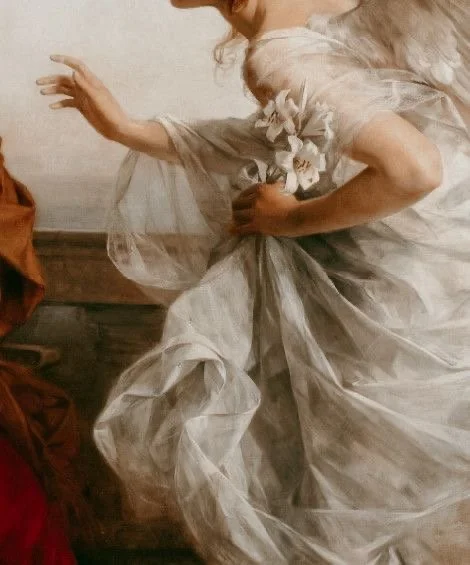
Rudolf Bacher, detail of the Ave Maria, 1890 —
‘(…) common-sense had illumined her. She felt that she would do well to be useful again — to taste anew sweet independence at any price. The past was past; whatever it had been, it was no more at hand. Whatever its consequences, time would close over them; they would all in a few years be as if they had never been, and she herself grassed down and forgotten. Meanwhile the trees were just as green as before; the birds sang and the sun shone as clearly now as ever. The familiar surroundings had not darken because of her grief, nor sickened because of her pain. She might have seen that what had bowed her head so profoundly — the thought of the world’s concern at her situation — was founded on an illusion. She was not an existence, an experience, a passion, a structure of sensations, to anybody but herself. To all humankind besides Tess was only a passing thought. Even to friends she was no more than a frequently passing thought. If she made herself miserable the livelong night and day it was only this much to them — ‘Ah, she makes herself unhappy.’ If she tried to be cheerful, to dismiss all care, to take pleasure in the daylight, the flowers, the baby, she could only be this to them ‘Ah, she bears it very well.’ Alone in a desert island would she have been wretched at what had happened to her? Not greatly. (…) Most of the misery had been generated by her conventional aspect, and not by her innate sensations.
Whatever Tess’s reasoning, some spirit had induced her to dress herself up nearly as she had formerly done, and come out into the fields (…). This was why she had borne herself with dignity, and had looked people calmly in the face (…).’
Thomas Hardy, Tess of the d’Urbervilles, 1891.