Why we sing
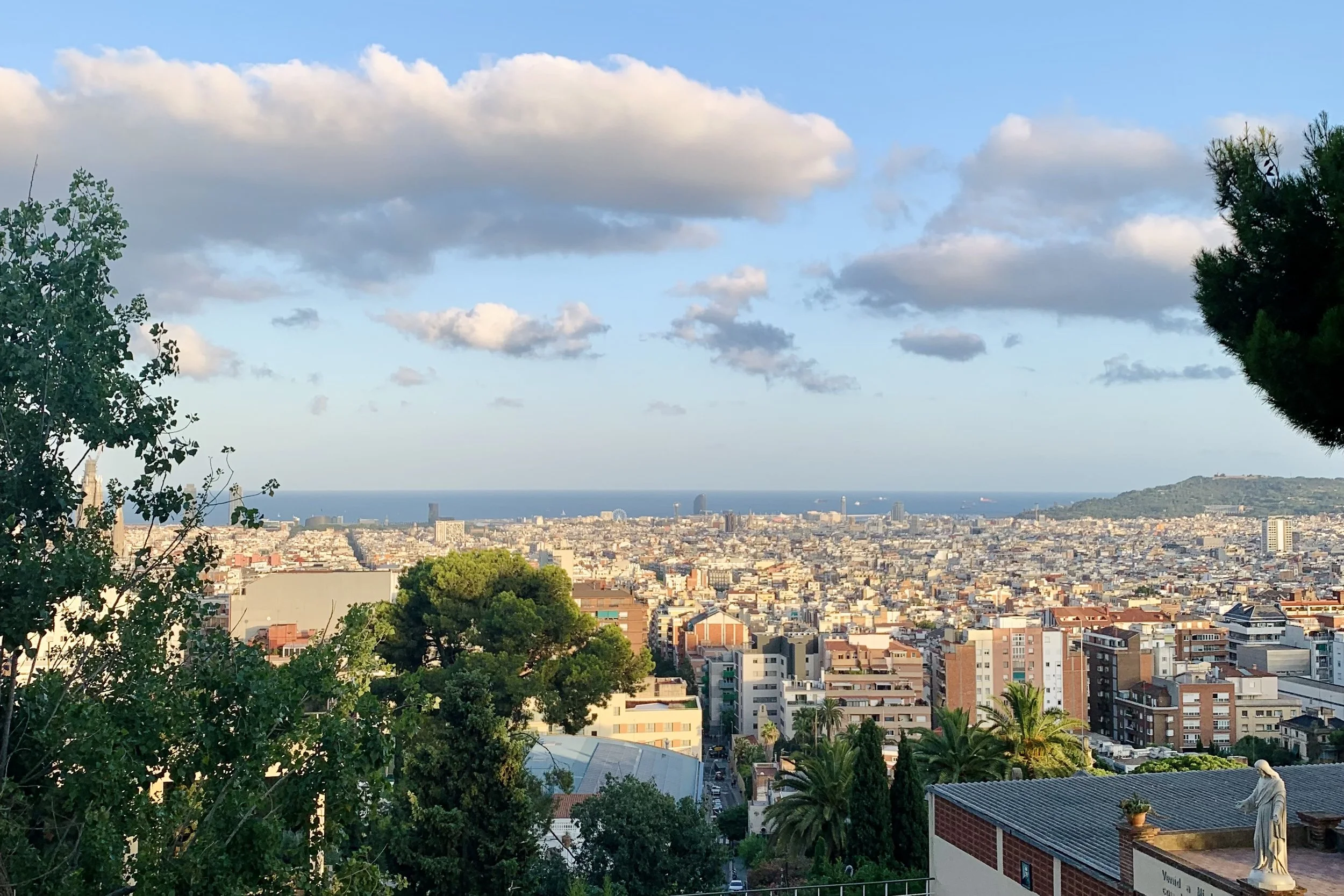
Sunset over Barcelona, from the third floor of the Cottolengo
10/05/2026 — Cottolengo del Padre Alegre, Barcelona.
Dear Lidy,
I’m trying to write an article about the concert we gave this morning at the Cottolengo, but it’s so hard to put such a profound experience into words.
The patients were over the moon, the nuns had put on their sunglasses – they looked like Hollywood stars! Loretta spent the whole concert with us, clapping her hands at the wrong moments, shouting “Yippee!” during the serious parts of the concert, and standing in front of the microphones – she was the only one we could hear (and she was out of tune). And if I could laugh about it with her today (and we did), it’s because we’ve been through a few adventures together over the past three years.
The place
My first article on the Cottolengo began like this:
“It is as big as a building, but it’s a home. It is a home for people with severe disabilities (mental and/or physical) who would have nowhere else to go but the streets if the nuns Las hermanas servidoras de Jesús did not welcome them there, at the top of Mount Carmel, right next to the Park Güell. And when, from the windows of the third floor where I am assigned, I look over the view of Barcelona, all the way to the sea, I reflect on the meaning of the word poor. The residents here are poor, too poor to stay with their families for instance, but even the princes of this city do not have a view like this. God really takes good care of his friends.”
Ever since I started volunteering, I’ve been assigned to the third floor – the girls’ floor. The youngest is four, the oldest perhaps forty. You could call them ‘the patients’ or ‘the residents’, but none of them has any problem with the former. They know the word ‘sick’ carries no value judgement.
Over time, we’ve come to know each other a bit. The routines, the good days, the bad days, the forgivable mistakes and the ones we mustn’t make again. Week after week, month after month, I’ve made them smile, I’ve wiped their tears, I’ve listened to their problems, and they… (Sigh) They’ve seen me grow.
And so, every year, we come with the gospel choir and put on a spring concert.
Daily life
It’s a constant paradox between military life and that scene in Jumanji where a horde of wild animals burst out of the elevator doors and charged down the corridor, sweeping everything aside in their path. You come, but you never know what’s coming.
Joking aside, there are about twenty of them living together, and each speaks her own language, which you have to observe to understand. Some speak, others don’t; one is blind, another has a physical disability. And there are even a few of them who never get out of bed. Can you imagine? A daily life consisting of a bedroom ceiling and a floor’s corridor. Every birthday. Same ceiling, same corridor.
What I am trying to depict here is the contrast between their daily lives (which could be so monotonous were it not for the Sisters’ constant care and sacrifice) and what we come to offer on a Sunday morning, in May, when most of us could have gone away for the weekend or had met friends on the beach, sun-bathing.
There were over a hundred and fifty of us. It blows my mind when I see that, and there’s always a moment during concerts when I turn around. Just to look. A hundred and fifty people, all equally volunteer, choosing to give their voices, and their hearts, and believing it was worth it.
Alive VS perfect
It’s not always easy. There’s this exercise our director makes us do, usually at the beginning of the year, which consists of pairing up: one person holds out their hands, palms facing up, whilst the other places theirs on their partner’s, barely touching them. The latter must then close their eyes and, trusting their partner, let themselves be guided. The other person will move around the room, having to avoid the others, the obstacles (and avoiding causing their partner to panic).
From a psychological and social perspective, this is an incredibly interesting exercise. Many fears and buried childhood memories resurface, simply through the way each person (1) places their hands (calmly, or anxiously at the thought of having to let themselves be guided, losing control?), or (2) takes the other person’s hands (ditto, having to take control).
But why am I telling you all this?
Because I’ve realised that the worst enemy of creativity, of life itself, is control. The need to do everything perfectly. The urge to grab the other person by the wrists to make sure they don’t move too much (or at least, not in any unexpected way).
It’s hard to let things be. To leave a smudge on a painting, or a clumsy sentence in a text, or to let them shout “Yippee!” when it would have been better to keep quiet.
And God knows I’ve always struggled with perfectionism (you know that all too well…). But not this morning. Not when I see Loretta so happy, running to fetch her friend in a wheelchair to dance with her.
Last year, she couldn’t come, even though she loves singing. And I thought it odd. As it turned out, she was actually having one of her episodes (a crisis), and we didn’t see her for months. And Mina today, who didn’t seem quite sure if she was allowed to be there, right in the middle of it all, dancing with her arms raised… Her illness might not allow her to live until next year for our next concert. So I think she’s understood why we sing. And I won’t be the one to tell her to keep quiet. —
Video : Clarence Bekker.
The PDF version here — Print it, save it, share it.