La traiettoria calante
Pietro Giannini on the collapse of the Morandi Bridge (Genoa, 2018) … or the corruption of the Italian system?
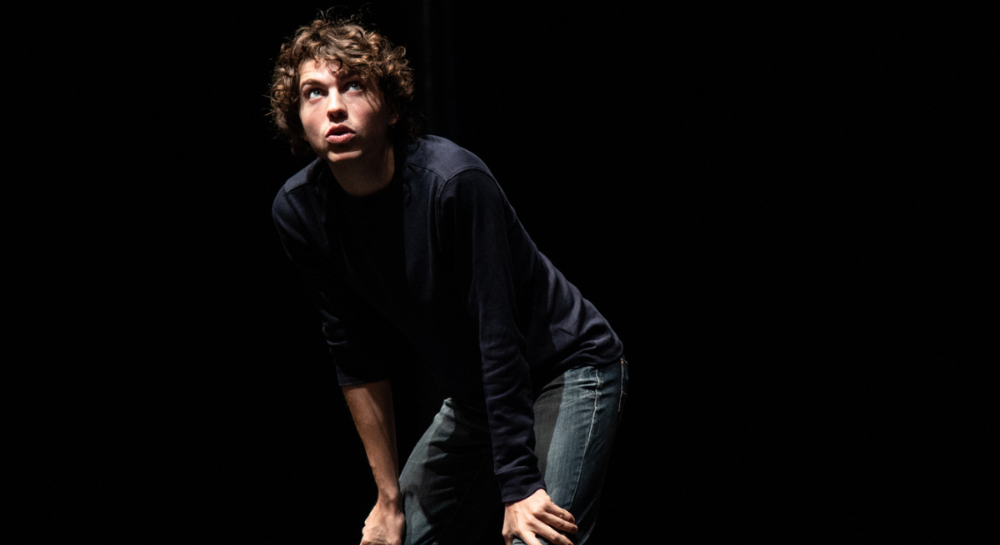
Pietro Giannini at the Akadèmia Theatre, Barcelona, April 2026 | Photo credit: I didn’t find any ! If you’re the photographer, please manifest yourself —
It begins with a legend. That of a peasant who, whilst fainted, meets John the Baptist, the patron saint of Genoa. The saint takes him to a flourishing valley where the air is fresh and the soil fertile. He works the land, and it yields fruit. And he believes that all is good, that he is the master of everything he produces. But one day, on the road, he meets the landowner, il signore, who, high on his horse, told him that in reality, everything belongs to him. “Everything you see—the trees, the plants, the animals, the land— everything is mine. Mine! Andyoutoo are mine!” The peasant jumps. Me? Belong… To whom?
To obtain his freedom, he tries even harder, working himself to the bone to amass wealth. But one night, the house burns down. Everything goes up in smoke. All that remains beneath his feet is fine ashes. Then Saint John the Baptist appears to him once more, and, angry, rebukes him: ‘I gave you the earth, and you could not resist the temptation to make it your slave. Now go empty-handed, and repent. Go to the castle and there, make your offering.’
He sets off alone, with ash still clinging to his feet and a mule as his only possession, and after days of travelling, at last, the view opens up. The castle, the moat, the bridge. Before the entrance, he kneels. The lord at the window, Saint John atop the tower… The serf makes his offering. Peace is made. But suddenly, the ground shakes, and with a gasp, he realises: the bridge is collapsing…
The actor
From an outsider’s perspective, the story seems confusing, but that is the nature of Italian theatre: the rich get richer, the poor pay the price and fall ill. The actor knows this all too well, and alone on stage, he decides to speak out anyway. He is in his early twenties. His age is surprising, I must confess. What could such a young man – a Candide – possibly have to teach an audience who had already been driving for fifteen years by the time he was born? Out of curiosity maybe, we listen all the same. The monologue is in Italian, with Catalan subtitles above his head. The locals are thoroughly enjoying this detail, and he spares no effort to turn his moments of improvisation into an opportunity to honour the language. The audience connects, gets involved and the road, behind him, goes by on a giant screen. We know where all this is leading, and to be honest, we’d rather not think too much about it.
The protagonists of the story? We’ll do as when reading a play. A list, at the beginning, of all the characters who will make an appearance:
Riccardo Morandi: The engineer who designed the bridge.
The Benettons : Yes, the very same who founded United Colors of Benetton.
Giovanni Castellucci: Chief Executive of Autostrade per l'Italia (ASPI).
Silvio Berlusconi: Italian politician who served as Prime Minister three times between 1994 and 2011.
SPEA: “Società Progetto Edili Autostradali”. An engineering firm specialised in road infrastructure inspection. It should be noted, for later, that SPEA is 80% owned by the Mundys Group.
Condotte d’Acqua: a civil engineering firm, best known for having dug the Mont-Blanc Tunnel.
Giuseppe Saragat: President of Italy from 1964 to 1971.
Gabriele Camomilla: An engineer appointed by Morandi to oversee the technical monitoring of the bridge.
The Mediterranean Sea.
An age-old friend: greed.
The bridge
Eight columns spaced at equal intervals, followed by three massive towers successively spanning the Polcevera River, the railway lines and the industrial districts of Genoa. As the last three towers are further apart, they are reinforced with stay-cables.
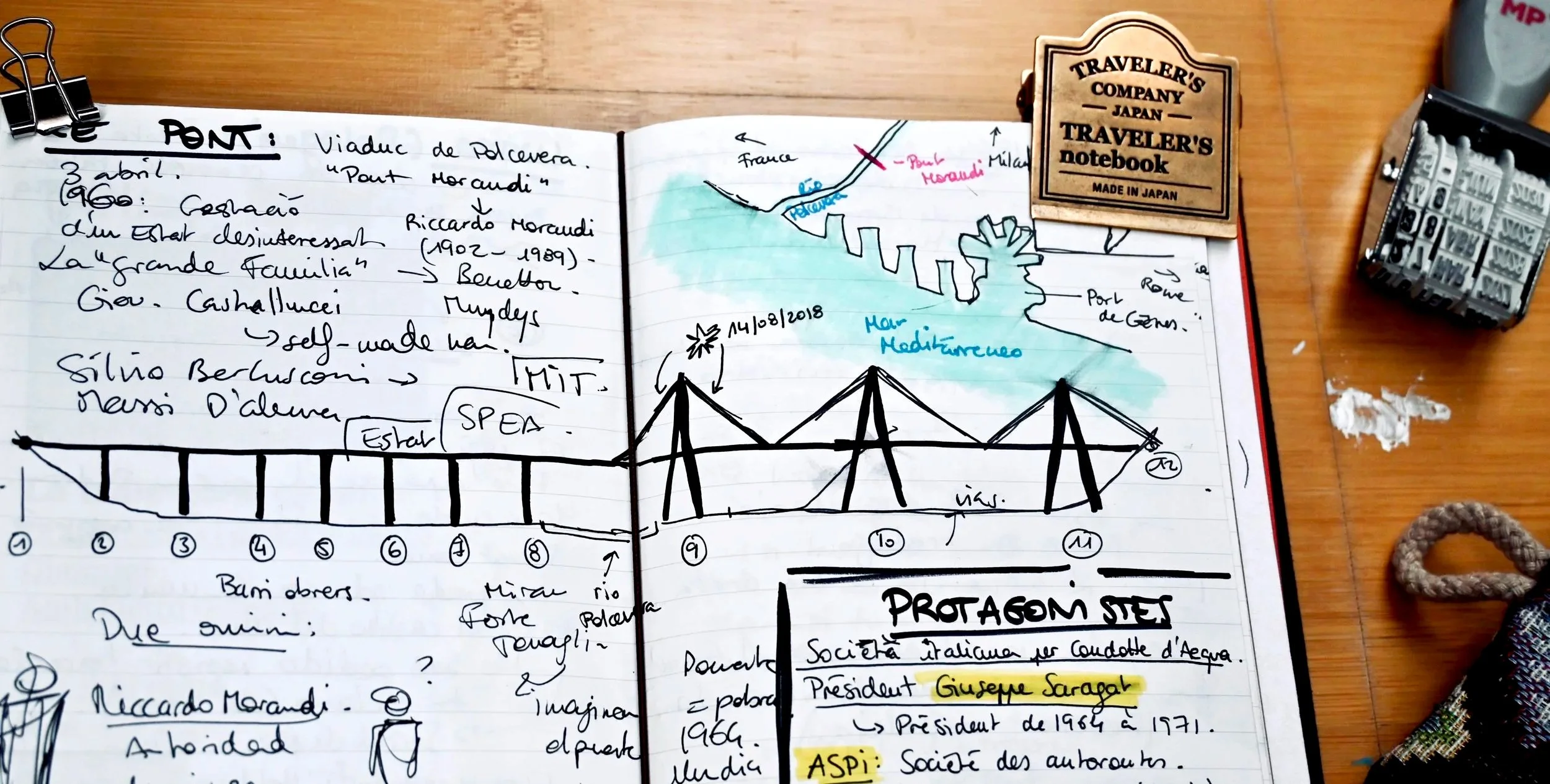
In 1960, Riccardo Morandi conceived this ambitious project: to connect the industrial, productive West to the affluent, powerful, consumerist East. The West produces and the East exports, generating profits. Between the two lay the “Brooklyn Bridge,” as it was nicknamed by the Genovese. After the war, steel was scarce and expensive, so Morandi decided to use prestressed concrete, a type of concrete reinforced with wire strands. In 1964, during an inspection, Morandi feels water dripping on him: the structure wasn't waterproofed as it should have been. But they had to work quickly, to show that Italy was recovering: the construction process was accelerated.
In 1967, two inaugurations took place. Two pieces on a complex chessboard, whose fates were intertwined. The first was that of the bridge, inaugurated by President Giuseppe Saragat. Accompanied by his entire entourage, his crossing also served as the first test of the bridge’s load-bearing capacity. (And the actor adds: Metodo italiano, right? If the president can cross, so can everyone else.) The second, took place 300 miles away, in the town of Belluno. A young entrepreneur, Luciano Benetton, opened the doors of a modest clothing shop, which would soon gain international reach.
In 1981, fourteen years later, Riccardo Morandi drew up a report in which he himself acknowledged that the bridge “was in a serious state of deterioration”. He admitted to having underestimated the impact of industrial emissions and coastal winds, which had created a fatal enemy: corrosion. The proximity of the sea was a real problem. Water ingress was far more severe than anticipated; the stay-cables supporting towers 9, 10 and 11 were severely corroded, and he specifically named Tower N°9 for the first time. Morandi had predicted the “death of the bridge”.
In Christmas 1989, Morandi passed away and, in his will, entrusted responsibility for his project to Gabriele Camomilla, who stated that, following an inspection, Tower 9 was “in much better condition than Towers 10 and 11”. A few years later, an engineering journal published an article describing how the stay-cables were “in a frightening state of degradation”. In both cases, no action was taken.
1994. Italy, represented here by Silvio Berlusconi, is in the midst of an economic crisis and needs to pay off its debts. He decides to privatise (= sell) the public assets. This period is known as the era of privatizacione.
Pause. The actor chooses a volunteer from the audience. Paolo, what’s your favourite colour? Yellow, perfect. Would you like to paint all of Italy’s highways yellow? Why not? You can now. You are the proud owner of Autostrade per l'Italia.
Now, Paolo and I are going out for a coffee. When it’s time to get the check, he feels his pockets: oops, he’s forgotten his wallet. What do I do? I don’t really have a choice: I’ll treat Paolo.
Luciano Benetton, in order to become the main shareholder of ASPI, borrowed 7 billion from UniCredit. Not particularly keen on the idea of having to repay such a loan himself, he decided… (to leave his wallet at home)… He decided, through various financial maneuvers, to reinvest the money in a new company, which would itself repay the loan (a maneuver known as a ‘leveraged buyout’ in the jargon). Atlantia became Mundys. The Benetton era had begun.
The tragedy
In 2009, a report was published – which could have been titled “The Benjamin Button Bridge” – announcing that the towers, which had not been inspected since the 1990s, were “showing improvements”. Michele Donferri, ASPI’s maintenance director, was instructed to spend as little as possible; he spoke of mere “losses of aesthetic functionality”.
Every year, new warnings were issued, reports published, but then destroyed or simply ignored. However, “No alerts are triggered by the electronic maintenance systems”, so is everything fine, right? In 2015, it was discovered that the reason the alerts hadn’t gone off was because rats had gnawed through the cables.
In 2017, with new investors stepping in – in that case Germany and Japan (Italy, Germany, Japan...) we start to hear about “retrofitting”: whilst unable to admit that urgent and fundamental repairs were needed, a plan was quietly put in place for renovations to take place the following year, in September.
But the bridge wouldn't hold that long. On August 14th, 2018, at 11.36 am, the stay-cable on Tower 9 snapped, and the structure began to shake. The bridge collapsed, taking more than fifty people with it.
Epilogue
Giovanni, Gerardo, Samuele, Luigi, Melissa, Alberto… “The oldest was 61,” the actor specifies. “The youngest, 7.” Forty-three people lost their lives in the disaster, sixteen narrowly survived. And their families, still grieving, stand on the remains of the bridge in a final shot. They look at the camera in silence; their gaze is almost unbearable. Behind them, in the upper left corner, a constant stream of cars crosses a brand-new, shiny white viaduct. The bridge has already been replaced. —
N.B: To understand the modern Italian political system, it helps to know its history. Watch Il Gattopardo, a film by Luchino Visconti (1963), and, more recently, a Netflix series based on the novel by Tomasi di Lampedusa.
The PDF version here — Print it, save it, share it.
♡