

#4 - The next day
The horror of it all was that I had prepared everything in advance. Backpack, passport, essentials. A few days later, they’d be waiting for me at the airport. At that moment, I’d imagined only two possible endings to that story: escape, or death and I had chosen both. I was leaving killing her, the Eva everybody (…)
“1) THE NECESSARY SEPARATION:
The desire to disappear or to see the other disappear is the ultimate signal of a cry for help that is vital to hear. Behind this desire (for ‘it to stop’) is the call of life.’” ¹
The call of life. — Genesis 19:17
I thought I saw a flash of lightning. It was 6:18 am, or something like that. It was 6:14, actually, last time I looked, but I guess it takes a good four minutes to put your shoes on, unlock the door and get the hell out.
The horror of it all was that I had prepared everything in advance. Backpack, passport, essentials. A few days later, they’d be waiting for me at the airport. At that moment, I’d imagined only two possible endings to that story: escape, or death and I had chosen both. I was leaving killing her, the Eva everybody remembered. And I was born, me, nameless still, with nowhere to go. Same little ghost who was trying to convince the public that yes, it was there.
In the street, everything was dark, still. I was thinking about Lot. I got startled by noises, but it was just the baker getting ready to open. I went on a bit faster. They’re still sleeping, you think? But who are you talking to? I thought. Just for a moment, the sky intensified — an ultramarine blue. So I knew it wouldn't be long before dawn.
I chose a bench in the middle of the esplanade, facing the mountains, to look at the sky. There were still a few stars. It seemed like an interesting place to start living. A homeless man — I saw him coming from a distance — was approaching, staggering, and I was afraid he would come and talk to me. He came closer, and closer, spoke, but to himself, and continued on his way. I sighed. So I came back to my dawn and to this other sentence from Genesis:
‘The sun had risen upon the earth when Lot entered Zoar.’ ²

I could have NOT disappointed them. True. Not broken their hearts, leaving home like that. But I could have breathed my last too, and about that, they'll never know. For them, I'll just be the missing child from now on. If I had chosen death, they would have mourned me. But as I chose life, they'll have plenty of time to hate me… It’s okay. You have to take the time to do these things. It's important.
But then you’ll have to rebuild yourselves… Personally, I planned to watch the sun rise. That was one reason to live. Until I asked myself the question again. The blue was changing for a beautiful cerulean, now turning gold. I was waiting my turn.
In the distance, a woman was walking quickly. I could see her silhouette pacing up and down the avenue. She disappeared from my field of vision and reappeared a moment later, right in front of me, agitated. She started talking and talking ; I stared at her, dazed, as if she were speaking a foreign language. She explained that she was looking for her son. That she had woken up around 5am that morning and didn’t find him there. ‘15 years old. Brown hair, white T-shirt, about this size... I won’t punish him, you know. I just want to find him.’ She looked pitiful, I wanted to help her.
The problem with this woman — and she had no idea, of course — was that she was showing me how mothers feel when they can't find their offspring in their bed, where they belong. And it was really not the right time. I nodded and muttered ‘Sorry’.
It was a strange scene, because there wasn’t this atmosphere of absolute solitude that usually goes with all the great moments of a character facing his destiny. I had taken the leap. Left everything behind. Family, work, comfort, home… I had nowhere to go, and I was going there with a pair of old jeans and a soon-expired passport. For me, it was the adventure of a lifetime. For the baker, the mother, the homeless man, it was a morning like any other. There was only one person in the world who could understand the exceptional nature of this day. And the last thing I'd done with her was pick up broken glass. This idea has obsessed me since. —
¹ : C. Eliacheff, N. Heinich, Mère-fille: une relation à trois, (2010), Ed. Albin Michel.
² : Genesis, 19:23
The PDF version here — Print it, save it, share it.
♡
#3 - What women talk about amongst themselves
I remember. It was this book that started it all. The paranoia, the escape, the wandering from one end of the city to the other... It was the book. (…) Out of curiosity, I opened it. I thought it wouldn't hurt to flip through it. Well I was wrong.
With all due respect to these gentlemen, their mothers —
‘From control to narcissistic abuse:
(...) Narcissistic abuse is the projection of the parent onto the child, whose gifts are exploited not to develop her own resources but to satisfy the parent's need for gratification. (...) It is an abuse of identity, the little girl being put in a place that is not hers and, correlatively, dispossessed of her own identity by the very person responsible for helping her to grow. (...)
The mother's over-investment is accompanied by a lack of real love, which the child transforms into a lack of self-esteem, an insatiable demand for recognition and an unfulfilled need for love. The ‘gifted’ child never ceases to multiply her prowess in order to merit, through her gifts, a love that is always unsatisfying because never directed towards herself, for herself. (...) ¹
[Diary, Oct. 2018:] ‘I can't go on. It's terrifying. It's as if this book were an oracle of my life. It's all written down: the constant pain, the bulimia, the desire to hurt myself, to starve myself to death... the wish to disappear. The worst things I can't even confess to myself. (...) I'm scared. Dr M.’s office is closed and I have nowhere to go. The only thing I know: I can't go home.’
I remember. It was this book that started it all. The paranoia, the escape, the wandering from one end of the city to the other... It was the book. In my ghostly delusions, I ended up in the library and found myself face to face with this book — Mother-Daughter: A Relationship of Three. Out of curiosity, I opened it. I thought it wouldn't hurt to have a look at it. Well I was wrong.
The child prodigy is torn between smallness and greatness, self-hatred and self-love, the interiority of being and the exteriority of doing, the darkness of secret suffering and the light of a glory offered in vain. Such is indeed the fate of the little girl when her mother, oblivious to her own identity as a woman, has entrusted her with the task of realizing her aspirations in her place.’ ²
It was as if the world had slipped away from under my feet. I had the feeling that someone was observing me. ‘This need for love can never be fulfilled because the signs of solicitude are never really addressed to the child.’ It was joke, wasn’t it? Someone had let the damn book there, just to make fun of me.
‘[Maria, from the movie Bellissima] would undoubtedly have become a brilliant young woman [if she had had any special gift] but nevertheless, always hungry for narcissistic gratification, alternating periods of excitement and depression, overactivity and inertia, always eager to please but generally unloved, probably bulimic as well as concerned about her figure, emotionally immature as much as sexually savvy.’ ³
‘From there, something clicked inside my brain. I saw the truth. I was in the eye of the storm, suddenly very serene because everything appeared to me as a powerful revelation, with only one possible outcome: escape or death.’
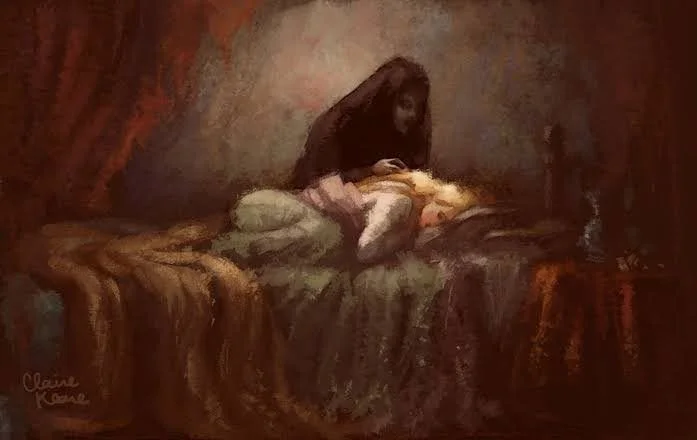
Think about Rapunzel, who has never touched reality, not even close. Lacking knowledge of what it is made of, she has imagined a world. And in this world, all the characters in the story want to hurt her. And she is right, in a way, because without a voice of her own, everyone is free to put words in her mouth that she never wanted. But the liberating question is not: who is on my side, really? And who has been pretending all this time?
But rather: who has more to gain if Rapunzel stays in her tower?
Artist : Claire Keane, her website here.
MARIA (to her mother): You know what would actually help me? If you’d loved me less. —
¹, ², ³ : ‘When women get together(...), what do they talk about? With all due respect to these gentlemen, their mothers. So argue Caroline Eliache and Nathalie Heinich in their book on mother-daughter relationships.’ — C. Eliache , N. Heinich (2010). Mère-fille: une relation à trois. Ed. Albin Michel —
The PDF version here — Print it, save it, share it.
♡